



Retinal Surgery
The human retina is a complex, light-sensitive tissue layer at the back of the eye. It contains photoreceptors, such as cones and rods, that convert light into electrical signals. These signals are transmitted via the optic nerve to the brain, where they are interpreted as visual information. The retina plays a crucial role in the perception of light, colors, and shapes, and its health is essential for clear and sharp vision.
Epiretinal Membrane
The English word “pucker” means “wrinkling” in German. During microscopic examination of the eye, e.g., with optical coherence tomography (OCT), a surface wrinkling of the macula can be visualized. The cause of this wrinkling is a thin cellophane-like membrane that overgrows the inner surface of the macula and, due to its contractile properties, leads to wrinkling of the otherwise smooth inner retinal surface at the point of sharpest vision, namely at the macula. Other terms for the same condition include epimacular gliosis or macular membrane.
These membranes can be surgically removed from the retinal surface. Under microscopic view and with very fine instruments, this layer is peeled from the retina. The underlying retina can then regenerate, often over a longer period of time. The improvement may take over a year, sometimes even longer.
Macular Hole
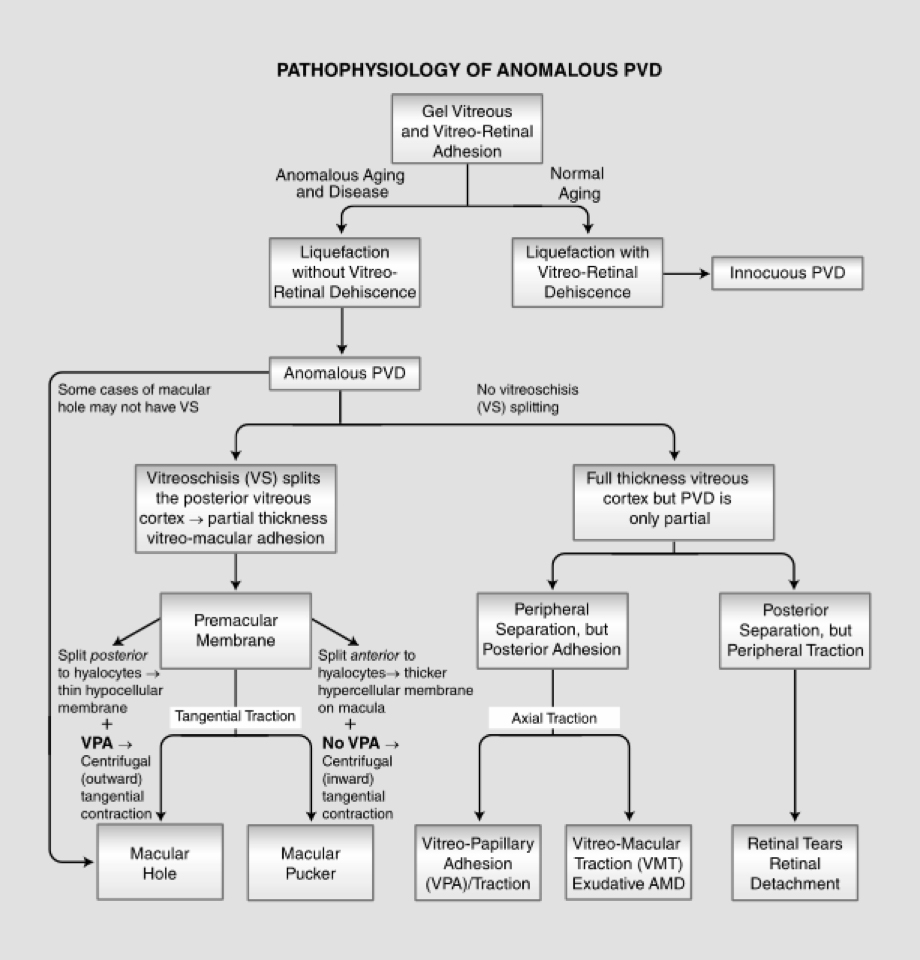
Foramen is the medical term for a hole. If a hole occurs at the point of sharpest vision, this means a severe impairment of central visual acuity. With OCT, this opening of the foveal pit can be precisely visualized and its extent accurately measured.
This precise imaging provides the basis for deciding whether surgical therapy is appropriate. In a surgical approach, vitreous adhesions are removed and in most cases a membrane lying on the macula is also peeled off.
Filling the vitreous cavity with gas and positioning for several days after the operation are necessary to create the conditions for closure of the macular hole.
Retinal Detachment
If you experience symptoms such as light flashes, streaks, soot rain, shadows, or similar phenomena, seek an ophthalmologist as soon as possible to rule out the formation of a retinal tear.
Retinal tears or smaller retinal holes can become starting points for retinal detachment.
Treatment of Retinal Tears
To prevent further progression of retinal holes up to retinal detachment, these retinal changes are treated with a laser or with cryotherapy to reinforce these weak spots through scar formation.
These treatments need to be performed promptly. In most cases, a major surgical intervention can be avoided.
Retinal Detachment
If a retinal detachment has already formed, only surgical intervention (scleral buckling, pneumatic retinopexy, vitrectomy) can address this critical situation. The timing and choice of procedure depend on the individual situation. The operation is usually performed within a few days.
However, careful surgical preparation is more important than a rushed surgical approach.
Often, specific patient positioning before surgery can improve the anatomical situation.
Since the healing process after surgery for retinal detachment can also become complicated, it is even more important to promptly consult an ophthalmologist when symptoms suggest possible retinal damage!
Approximately 80–90% of retinal detachments can be treated with a single operation. However, some patients require follow-up procedures to stabilize the retina.
Symptoms that may indicate retinal detachment:
At the point where the retina detaches, a visual field defect is noticed. Only when the retina is reattached can it resume its function.
The retinal defect may manifest as a dark shadow. This shadow appears at the edge of the visual field and may grow larger over time. Ultimately, the affected person would see nothing if the entire retina were to detach.
The visual field defect is always opposite to the side of the retinal detachment. Thus, a shadow from above means the retina is detaching from below, or a shadow from the left means the retina is detaching on the right side of the eye, etc. Most commonly, the retina detaches from the upper outer area, so in these cases the shadow rises from the inner lower area upward.
The speed of retinal detachment can vary greatly. Sometimes the course can be so dramatic for the patient that vision in the affected eye fails within hours.
Fortunately, the retinal tissue is supplied by its own vascular system, so the tissue remains intact. When the retina regains contact with the underlying pigment layer of the eye, it resumes its proper function.
Pain is not a characteristic of retinal detachments, as the retina has no pain receptors.
Macular Edema
A swelling of the macula (= macular edema) can have various underlying causes. Macular edema most commonly occurs in diabetes, vascular occlusions (e.g., branch retinal vein occlusion or central retinal vein occlusion), chronic inflammation (e.g., chronic uveitis), sometimes after surgical procedures such as cataract surgery, retinal surgery, glaucoma surgery, or as described above, in epiretinal gliosis (macular pucker).
Therapeutically, anti-inflammatory medications are used as eye drops, as injections beside the eye, and also as injections into the vitreous cavity. The most common drug groups are non-steroidal anti-inflammatory agents, dehydrating medications (e.g., Diamox), corticosteroid preparations, and anti-VEGF medications (Lucentis, Avastin).
Macular edema after surgery can usually be completely resolved through treatment. Macular edema caused by circulatory disorders may recur multiple times and then requires repeated treatment.
For diagnosis, optical coherence tomography (= OCT) is usually employed, thus often making a fluorescein angiography unnecessary.
Diagnostics
Fundoscopy
To detect possible weak spots in the retina, the ophthalmologist will carefully examine your retina.
Prevention means, especially when symptoms occur, visiting an ophthalmologist promptly, at least within a few days, and also having examinations even without symptoms,
- if you are nearsighted.
- if retinal detachments have occurred in close relatives.
- if you have had an eye injury.
- if you have had eye surgery (your ophthalmologist can assess your specific risk).
- if your birth weight was very low.
Through preventive examination, precursors of retinal holes can be found. Prophylactic laser treatment of these precursors of retinal holes can prevent an actual retinal detachment that could originate from this location.
If the retina has already detached, this measure is no longer sufficient and the retinal detachment can only be treated surgically.
OPTICAL COHERENCE TOMOGRAPHY (OCT)
OCT is the worldwide standard in the diagnosis of retinal diseases, especially of the macula, and of optic nerve diseases, e.g., glaucoma.
It has become the world’s most important instrument in the diagnosis of macular diseases and is therefore the essential examination procedure for evaluating AMD, macular edema, macular holes, or so-called macular puckers.
The principle is based on measuring the reflection of a light beam sent into the eye and converting it into a visible image through digital technology. The resolution is 10 micrometers.
The procedure is painless and completely harmless.
OCT is not included in the benefits catalog of statutory health insurance. This examination must therefore be billed as a private medical service.
Ultra-Wide-Angle Laser Scanning
The Optos Ultra-wide-angle laser scanning technology creates high-resolution, digital retinal images that facilitate the early detection, documentation, and treatment of ocular pathologies as well as systemic diseases. The visualization of vitreous opacities with the Optos system is particularly outstanding.
In a single, quick capture, a view of up to 200° (approximately 82%) of the retina is obtained. In comparison, conventional methods show only about 45° of the retina in a single image.
This technology was developed to protect people from visual impairment, blindness, and serious conditions such as diabetes, cancer, stroke, and heart failure.
The Optos scan is not included in the benefits catalog of statutory health insurance. This examination must therefore be billed as a private medical service.
Treatment
Prof. Koss is a two-time recipient of the highest-decorated award of the German Ophthalmological Society DOG (Leonhard Klein Prize) for his surgical innovations in the field of vitrectomy.
Vitrectomy and Macular Surgery
In a number of conditions, a cure can only be achieved through surgical intervention.
In almost all cases, it is necessary to remove the vitreous body in order to perform surgical measures directly on or beneath the retina. This surgical complex is described by the term “vitrectomy,” which literally translates to “cutting out the vitreous body.” However, this process alone represents only one aspect of often complicated procedures.
Frequently, these procedures are combined, in eyes that still contain the natural lens, with removal of the lens and simultaneous replacement with an artificial lens.
The surgical access into the vitreous cavity is through the area of the so-called pars plana of the ciliary body, so the more precise description of this surgical procedure is pars plana vitrectomy (or abbreviated ppV). The access points are located approximately 3.5 to 4 mm from the cornea.
A vitrectomy is performed through minimally invasive access points into the eye. Depending on the size of the access, we speak of a 20 gauge, 23 gauge, 25 gauge, or 27 gauge vitrectomy. The access incisions are only 0.9 mm, 0.6 mm, 0.5 mm, or 0.4 mm in size.
The surgeons at the Eye Center Nymphenburger Höfe have immense experience in the treatment of all retinal diseases. In surgical procedures, they almost exclusively perform vitrectomies with a 23-gauge or 25-gauge system (0.6 mm or 0.4 mm). The wound trauma is minimal, even when the operation is combined with lens removal. Only in rare cases is a suture still necessary. The procedures are designed so that the access pathways close in a valve-like manner on their own.
Vitrectomy is considered in the following cases:
- In retinal detachments.
- In vitreous hemorrhages from various causes.
- In advanced proliferative retinopathy caused by diabetes. The excessive formation of blood vessels in the vitreous and retina can cause hemorrhages and retinal detachments in this disease.
- In macular diseases such as macular hole formation (= macular foramen) or adhesions at the macula (epiretinal gliosis = macular pucker) or in complicated cases of AMD.
- In vitreous opacities, e.g., in chronic or acute inflammation, or in massively disturbing other forms of opacities.
The operation is performed under local anesthesia and general sedation. General anesthesia is only rarely necessary. The combination of sedation and local anesthesia ensures that the operation itself is not perceived as distressing, sparing the patient from general anesthesia.
The surgeon uses a microscope and additional specialized lens systems for the procedure to perform the microsurgical manipulations on the retina.
The following steps are performed:
- To minimize the burden on the eye from the operation, our surgeons use the minimally invasive vitrectomy technique. The surgical instruments are only 23 gauge (0.6 mm) or 25 gauge (0.4 mm) in size. This allows tiny openings that heal without sutures.
- The gel-like substance of the vitreous body is carefully removed with a specialized instrument, the vitrector. The necessary procedures on the retina can then be performed, such as removal of adhesions on the retina, laser treatments, removal of fluid accumulations beneath the retina, and others.
- To stabilize the retina, function-specific fluids are introduced as needed as a replacement for the removed vitreous body.
Temporary stabilization can be achieved with gases that disappear from the eye on their own within a period of a few days up to 3–4 weeks. - In certain situations, longer-term stabilization of the retina is necessary. In these cases, only silicone oil can be used, which has proven to be the only substance suitable for long-term vitreous replacement for many years.
Important: Through our outpatient surgical facility, we can perform operations on an outpatient basis for privately insured patients and self-payers. It always depends on the indication and circumstances, but internationally (USA, UK, Spain) and nationally (Hesse, NRW, Brandenburg, Lower Saxony, Bremen) more than 80% of retinal operations are now safely performed on an outpatient basis. It is also important to discuss follow-up examinations with the referring ophthalmologist in advance.